PFTrack for Visual Effects
Spatial Data That Powers Every VFX Department
For over two decades, PFTrack has been the spatial intelligence platform behind Oscar-winning feature films, high-end episodic television, and world-class VFX studios. Camera data for compositors. Scene geometry for environment and lighting artists. Lens models for the entire pipeline. Photogrammetry for set reconstruction and digital doubles. From a single handheld shot to a thousand-shot episodic season, PFTrack’s node-based workflow delivers production-ready spatial data to every department that needs it, matchmoving, compositing, lighting, FX, layout, previs, and beyond.
Camera Tracking & Solving
PFTrack’s solver is the core of the application, an iterative optimisation engine that refines camera position, orientation, focal length, and lens distortion parameters until the 3D solution converges to sub-pixel accuracy. This is where PFTrack’s 20+ years of R&D investment is most evident.
Auto Track with ML-accelerated feature matching
Automatically detect and track hundreds of features across a shot. The machine-learning feature matching engine, introduced in the 2024 releases, adapts to motion blur, low contrast, fast camera movement, and partial occlusion more robustly than traditional correlation-based trackers. A new Localised Motion Prediction algorithm adapts to different motion types within the same shot.
User Track for manual precision
When automation isn’t enough, reflective surfaces, extreme motion blur, or shots with very few trackable features, PFTrack’s manual tracking tools give the artist direct control. Updated editing tools in the Cinema workspace allow track grouping, direct adjustment, and per-point refinement without leaving the viewport.
Camera and Survey Solver
PFTrack’s Camera Solver takes tracked features and computes the 3D camera path, scene point cloud, and lens parameters simultaneously. The Survey Solver adds known real-world measurements and constraints for higher accuracy. Both solvers now include a parameter refinement toolset giving direct control over which camera and lens parameters are adjusted during convergence, essential for complex multi-pass solves on difficult shots.
Object tracking
Track rigid and deformable objects moving within the shot. Geometry-based object tracking uses a 3D model to lock onto a moving element, producing accurate motion data for downstream roto, FX attachment, and CG replacement workflows.
Hero Cloud
When reference photography wasn’t shot.
Every matchmove team has the moment: the plates arrive, reference photography wasn’t captured, and a set extension brief is on your desk. Hero Cloud reconstructs a measured 3D point cloud directly from the plate you’ve already tracked. Use it for set extensions, CG integration, and lighting reference — or feed the output into Postshot for Gaussian splat training, or surface to a textured mesh via Photo Mesh in Studio and Enterprise.
Lens Distortion
Lens distortion is the silent killer of VFX compositing. Unmodelled distortion means CG elements slide against the plate, edges don’t match, and the illusion breaks. PFTrack’s distortion toolset is the most comprehensive in the industry:

New anamorphic distortion model (2025) generates accurate presets for a wider range of anamorphic lenses than any previous version.
Smart distortion calibration automatically analyses grid shots and determines the best distortion model to use — no manual model selection required.
New grid detection algorithm handles a wider variety of single and multi-level grid shots from different sources.
ST-map workflows for bidirectional distortion/undistortion pipelines.
Lens Management system exports distortion data directly into supported host applications (Nuke, Maya, etc.)
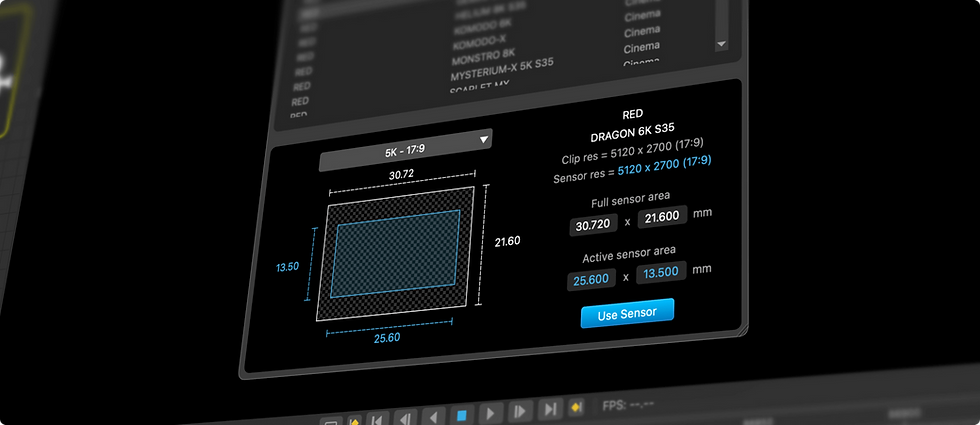
Camera Sensor Database provides verified sensor metadata for thousands of camera models, eliminating manual spec searches and ensuring focal calibration is physically accurate from the start.
Photogrammetry & Scene Reconstruction
PFTrack is one of the few matchmoving applications that includes a complete photogrammetry pipeline. This means the same tool that tracks your camera can also reconstruct the scene geometry, producing dense point clouds and textured meshes for set extension, environment rebuilds, and CG integration.

Photo Survey node
ML-accelerated feature matching across hundreds of images. Produces dense, accurate point clouds and textured meshes from still images or video frames. Memory usage optimised in the 2025 releases for larger datasets on macOS.
Image Modelling
Project camera views onto geometry to create textured 3D models of set elements. Now supports loading custom modelling primitives for more flexible geometry construction.
Point Cloud and Mesh tools
Faster point cloud generation, improved mesh quality, and better viewport performance with dense datasets. Export to USD, FBX, OBJ, Alembic, and PLY formats.
LiDAR-aided camera solving
Import LiDAR survey data and align tracked cameras precisely against the physical environment scan. Essential for shots where the camera track must match real-world geometry exactly.
Pipeline Integration
PFTrack is designed to sit at the start of the VFX pipeline, feeding spatial data into every downstream tool:
Export to Maya, Nuke, Houdini, Blender, After Effects, Cinema 4D, Unreal Engine, and more, including the new Maya 2026 export script that automatically parents image planes to the tracked camera.
USD export for modern pipeline architectures, enabling tracked cameras, point clouds, and scene geometry to flow into USD-based workflows.
Python API and CLI for automated shot setup, batch solve submission, and integration with shot management systems (ShotGrid, ftrack, etc.).
Macro scripting for creating reusable node graph templates that standardise your studio’s tracking workflow across artists.
Shareable user presets for consistent solver parameters and export settings across a team.
Who Uses PFTrack Data in the VFX Pipeline
PFTrack sits at the start of the VFX pipeline, but its output feeds every department downstream. Understanding who consumes PFTrack’s spatial data, and how, is key to understanding why it matters to the entire facility, not just the matchmove team:
Matchmove artists
The primary operators, building tracking setups in PFTrack’s node graph, solving cameras, and delivering camera data and scene geometry to the pipeline. PFTrack’s node-based workflow, ML-accelerated tracking, and solver precision are designed to make this work faster and more accurate.
Compositors
Receive tracked cameras, lens distortion models, and undistorted plates from PFTrack. Accurate camera data is the foundation of every CG integration shot, if the track is wrong, nothing downstream can be right. PFTrack’s lens distortion pipeline (including ST-map workflows and the Lens Management export system) delivers distortion data directly into Nuke and other compositing tools.
Environment and lighting artists
Use PFTrack’s photogrammetry and scene reconstruction output as the basis for digital set extensions, matte paintings, and lighting reference. Dense point clouds and textured meshes from PFTrack provide accurate scene geometry and real-world surface data that inform light placement, shadow direction, and reflection setup.
Layout and previs teams
Use PFTrack’s solved cameras and scene geometry to build accurate 3D representations of live-action plates. This enables CG element placement, virtual camera planning, and sequence previews that match the physical shoot precisely, long before final compositing begins.
VFX supervisors
Rely on PFTrack at a strategic level: ensuring tracking data is consistent across a show, verifying that on-set data (LiDAR, witness cameras, metadata) aligns with post-production solves, and using PFTrack’s photogrammetry for set surveys and reference capture. The node-based workflow provides an audit trail that supervisors can review and approve.
Pipeline TDs
Integrate PFTrack into the studio’s production pipeline using the Python API, CLI, and macro scripting. Automated shot setup, batch solve submission, export to shot management systems (ShotGrid, ftrack), and standardised node graph templates ensure tracking workflows are consistent and scalable across hundreds of shots.
Why Studios Choose PFTrack for VFX
Broadest integrated toolset
No other application combines camera tracking, object tracking, lens distortion, photogrammetry, LiDAR, and scene reconstruction in a single node-based workflow, delivering data to every department from one source of truth.
Node-based architecture
Non-destructive, repeatable, auditable, every tracking decision is preserved in the node graph. Artists can branch, compare, and iterate without losing work. Supervisors can review and approve the methodology, not just the result.
Cross-platform
Native Apple Silicon (M5 Pro/Max delivers excellent solve performance), Windows, Rocky Linux 8/9, deploy on any infrastructure.
Three editions for every scale
Solo perpetual for freelancers (with free trial including exports), Studio floating for teams, Enterprise for global facilities with air-gapped license deployment.
Perpetual licensing
Lifetime software updates on Solo, a pricing model that respects the freelance budget.
20+ years of production heritage
The algorithms are battle-tested on the most demanding shots in feature film history.
FAQ
PFTrack goes beyond traditional camera tracking by acting as a unified spatial intelligence platform. It is the only matchmoving application that integrates camera tracking, rigid/deformable object tracking, advanced lens distortion calibration, photogrammetry, LiDAR integration, and scene reconstruction into a single node-based workflow. Instead of serving only matchmove artists, PFTrack provides a single source of truth that delivers precise data to every department downstream, including compositors, layout teams, environment artists, lighting TDs, and VFX supervisors.
PFTrack features an ML-accelerated feature matching engine and a Localized Motion Prediction algorithm. This machine-learning core significantly outperforms traditional correlation-based trackers by adapting dynamically to complex shot challenges. It maintains robust feature tracks across frames plagued by extreme motion blur, low-contrast environments, rapid camera whip-pans, and partial or prolonged asset occlusions. When automation needs refinement, the Cinema workspace allows manual user tracking with direct per-point viewport control.
PFTrack provides a comprehensive lens management system to eliminate sliding CG elements and mismatched edges. Key capabilities include:
-
Smart Distortion Calibration: Automatically analyzes grid shots to select the optimal distortion model without manual intervention.
-
Anamorphic Distortion Model: Supports precision presets for a wide range of anamorphic lenses.
-
ST-Map Workflows: Offers bidirectional distortion and undistortion pipelines.
-
Camera Sensor Database: Includes verified metadata for thousands of camera models to ensure physically accurate focal calibrations.
-
Pipeline Export: Directly exports lens data into host applications like Foundry Nuke and Autodesk Maya.
-
PFTrack Solo provides single-shot scene reconstruction via the Hero Cloud engine, allowing independent artists to extract dense 3D point clouds directly from a single tracked camera move. For advanced, multi-image photogrammetry, PFTrack Studio and Enterprise add exclusive access to the Photo Surveyand Photo Mesh nodes to process large, multi-angle photo datasets into textured meshes, alongside native LiDAR survey data integration.
PFTrack is architected to sit at the absolute front of the post-production pipeline. It natively exports tracked data, lens parameters, and geometry to industry-standard tools including Autodesk Maya (including automated image-plane parenting scripts), Foundry Nuke, SideFX Houdini, Blender, Adobe After Effects, Cinema 4D, and Unreal Engine. For modern studio architectures, PFTrack fully supports Universal Scene Description (USD) pipelines alongside traditional FBX, OBJ, Alembic, and PLY formats. Studio automation is fully supported via a robust Python API, Command Line Interface (CLI), and macro node-graph scripting.
PFTrack is a fully cross-platform application optimized for Windows, Rocky Linux 8/9, and macOS—with native optimization for Apple Silicon (delivering industry-leading solve speeds on M5 Pro and Max architectures).
The Pixel Farm offers three flexible editions:
-
PFTrack Solo: A perpetual license with lifetime software updates designed for freelance artists, featuring a free trial that includes export capabilities.
-
PFTrack Studio: Floating licenses tailored for collaborative VFX studio teams.
-
PFTrack Enterprise: Scalable configurations tailored for global facilities, supporting air-gapped deployments using PFBucket.
-
Try PFTrack Free, Download PFTrack Solo and start tracking on your own footage today.
Managing a large facility? Contact Sales for Enterprise